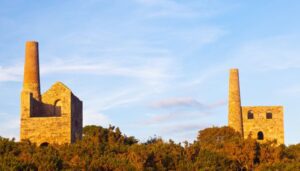
Cornwall has a fascinating mining history that stretches back over 3,000 years, making it a great topic to explore. Historians believe tin mining in Cornwall began around 2100 BC, making it one of the earliest mining regions in Britain and a key part of Cornwall’s industrial heritage. Learning about this heritage can add an extra layer of interest to family holidays in Cornwall.
Mining for tin, copper and china clay in Cornwall has played a major role in shaping Cornwall. The area is so rich in minerals because it was formed from a huge granite mass millions of years ago, with cracks in the earth allowing molten rock to rise through the stone. Many families camping in Cornwall enjoy visiting historic mining areas to help children connect with the landscape around them.
As this molten rock cooled, it formed mineral-rich veins containing tin, copper, iron and silver. Tin and copper were especially valuable to early communities, as they were used to make tools and weapons that supported daily life. Today, many Cornwall mining sites are protected and can be explored safely with children through organisations like the National Trust, which cares for several family friendly historic mining locations across Cornwall.
Roman metals trading in Cornwall: Tin, Copper and Early Trade Routes
When the Romans arrived in Cornwall around 43 AD, tin and copper were already highly valuable metals. Historians believe Roman interest in Cornwall was driven largely by metals trading, with tin and copper shipped from the county to mainland Europe via early trade routes. This Roman trade in Cornwall created a strong economic relationship between Roman merchants and Cornish mining communities.
Because Cornwall was valuable for trade rather than conquest, it was not seen as a major military target for Roman invasion. As a result, there are relatively few signs of large-scale Roman occupation. Some Roman forts in Cornwall remain, and a Roman villa was built at Magor near Camborne, but historians believe Cornwall’s tin and copper resources may have reduced the need for a full military invasion.
The Tin Mining Boom in Cornwall
The lure of tin trading in Cornwall heralded the arrival of ships from the eastern Mediterranean in the sixth century, bringing luxury goods for the Cornish people, such as wine and olive oil.
By 1337, Cornish tin production had rocketed to 650 tons per year, and 800 tons by 1400, marking a major tin mining boom in Cornwall. During the 1540s, tin mining in Cornwall was booming, using open cast mining methods. In 1689, Somerset inventor Thomas Epsley revolutionised The tin mining industry by devising a method to blast granite rock using gunpowder.
One blast moved the same amount of rock in an instant that it would take a group of miners with pickaxes six days to dislodge. As global demand for tin continued to grow and even small mines were able to benefit from the huge market.
Copper mining in Cornwall: Growth and Innovation
In the 1700s, the brass industry expanded, largely as a result of the growing woollen industry, where brass combs were needed. The demand for copper grew again as a result. It was found in many areas of Cornwall, often under the tin lodes. Deeper mines were needed, and this meant introducing better drainage methods to improve conditions for miners.
Steam engines were introduced in the 1730s, and with them came the icons of the Cornish landscape, the engine houses. They were found all over the mining districts by the 1750s.
The booming demand for copper grew further in the 1800s when it was used for coins and for the expansion of the Royal Navy due to conflicts at sea. The mining industry grew dynamically as a result.
China clay mining in Cornwall: From Porcelain to Industry
China clay mining in Cornwall developed much later than tin and copper. The material was first used in China to fashion high-quality white porcelain. When the beautiful items were traded in Europe, the wealthy wanted a change from earthenware pots. Porcelain became highly sought-after.
Plymouth apothecary William Cookworthy spotted a gap in the market and started to search for a material similar to the kaolin used in China for porcelain-making. In 1745, visiting Tregonning Hill, in Cornwall, he discovered a rare kind of natural granite that was finer than talcum powder.
Known locally as Growan, Moorstone, or Growan Clay; Cookworthy experimented with the material and found a way of separating it to remove impurities, using water. He spent 20 years developing a recipe to make porcelain, patenting his invention in 1768.
He founded the Plymouth Porcelain Factory, where he made fine china to sell to the wealthy, using china clay mined in Cornwall. He also started selling the raw material to other English potteries.
Cornwall: Mining centre of the world
By the late 18th century, Cornwall was the mining centre of the world. Mine owners led the global industry in terms of new, innovative technology. Local expertise was used as a basis for new mining regions around the world. International mining communities started to spring up.
Copper mining in Cornwall peaked in the 1850s, with the discovery of new copper reserves in east Cornwall – keeping production going at the same level until the mid-1860s.
The famous Camborne School of Mines was founded in 1888 in Falmouth, Cornwall. The university and mining school is still going strong today as part of the University of Exeter.
Cornish Life of a Miner
The life of a miner in the 19th century was tough. Cornish Mine shafts were narrow and often vertical, and the miners worked in cramped, hazardous conditions. Many mines had basic ladders for access. Having to climb up and down them, in the heat and dust, added to the daily grind. Some mine owners invested in cages to transport the workforce up and down, but plenty didn’t.
Arsenic was found underground in some mines, making the work even harder – miners often didn’t live past middle age. As well as men working underground, an estimated 7,000 children worked in Cornish mines in the mid-19th century. Boys were sent down the mine shafts to do an adult’s work as soon as they were physically able.
Women and girls were also employed by mine bosses, but they worked above-ground, these roles were critical to Co sorting through the ore and separating different materials.
Cornish pasties: The Miners’ staple in 19th Century Cornwall
The traditional Cornish pasty was the staple diet of every miner in 19th Century Cornwall. It had many advantages: it was light and easy to carry, as it could be slipped in a pocket and taken underground. The miners normally ate in the mine shaft, as there wasn’t enough time to take a break above-ground.
A Cornish pasty consisted of pastry containing meat and potatoes. However, some were savoury at one end and sweet at the other with jam, fruit or treacle – providing the main course and a dessert all in one! This trend has vanished today, although savoury Cornish pasties are now a famous part of Cornwall’s culinary heritage.
The thick pastry of Cornish pasties helped keep the filling warm. There was nowhere for the miners to wash their hands before dining, so the pastry had a thicker fold on one edge, so they could hold onto this and throw the soiled piece of crust away.
Decline of the Cornish Mining Industry: 19th-Century Challenges and Emigration
Following the mid-19th century boom in Cornish mining, the industry began to decline, largely due to cheap foreign competition. The price of tin and copper was eroded and the industry became less profitable in Cornwall.
Many workers faced redundancy at the end of the 19th century. Thousands emigrated overseas to find work, to places such as South Africa, Australia and North America, where the mining industry was relatively new. More than 10,000 miners reportedly left Cornwall to find work elsewhere.
Cornish mines began to close during the 20th century – and in 1986, a crash in the price of tin worldwide caused further downturn for the Cornish industry. The last working tin mine at South Crofty, near Camborne, closed in March 1998.
China clay is still produced around St Austell, the majority at Fowey and smaller quantities coming from Par Harbour. The Wheal Martyn China Clay Heritage Centre details the region’s historic china clay mining industry.
Tourist attractions
Today, the old mines and mining heritage are integral to the tourism industry in Cornwall, as many are World Heritage Sites owned by the National Trust. Mines such as South Crofty, East Pool Mine and Wheal Peevor are tourist attractions in their own right.
The South Crofty project, in the Pool and Camborne district, may see the old mine reopen in the future. A number of organisations, led by Cornish Metals, are collaborating on a feasibility study into whether the mine can become active again.
East Pool mine was operational, mining copper and tin in the Camborne and Redruth area, until 1945. Today, it is a famous visitor attraction and still has its iconic engine houses, Cornish beam engine and industrial heritage discovery centre.
Wheal Peevor Mine Site and multi-use trail, managed by Cornwall Council, opened as a visitor attraction in 2008. The site contains three Grade II listed engine houses, and the former derelict land is now used for recreational and educational purposes.
Where to see Mining Ruins in Cornwall
Cornwall is famous for its dramatic mining ruins scattered across the county… Many of these ruins can be easily accessed on popular walking trails and make great photo opportunities.
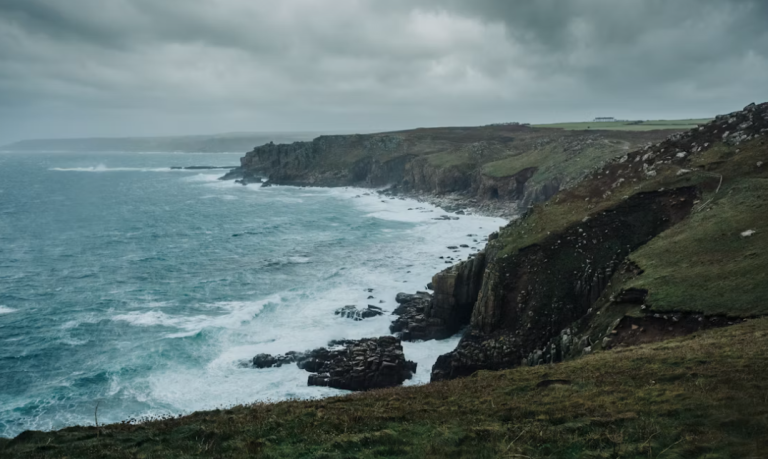
Botallack Mine Walk
Length: 1 Mile , ~ 45 Minutes
Difficulty: Easy
Terrain: Mostly level with some narrow and informal paths with un even surfaces near the cliff edge
Summary: A short walk through outstanding historical industrial sites set in coastal heathland, with rare wild flowers, all within the Cornish mining world heritage site. Kids will love spotting the dramatic clifftop engine houses
Blue Hills Tin Mine, St Agnes
Length: 1 Miles circular, ~ 45 Minutes
Difficulty: Moderate
Terrain: Field of the flower “heather” with fantastic ocean views, some uneven ground around the mine ruins.
Summary: A one mile circular walk along the South West coast path to the ruins of Wheal Coates Tin Mine. Kids will enjoy exploring the remains of the mine and looking down the mine shaft to the sea below. The National Trust car park is the only cost.
Wheal Coates Circular, Chapel Porth
Length: ~3 Mile, 1.5-2 Hours
Difficulty: Moderate/Hard
Terrain:A short sharp climb at the start, followed by a steep descent into Trevallas Coombe; otherwise a relatively gentle walk through industrial relics
Summary: A walk through the remnant of Wheal Kitty and some of the most important areas of Cornish Mining Heritage, with an optional visit to Cornwall’s only surviving tin stream works. A good walk for children, who will enjoy the mining history and the high views
When you’re planning a holiday in Cornwall, book your stay at Globe Vale Holiday Park in Redruth, from where you can explore some of the region’s rich mining heritage – Wheel Peevor is on the approach road to the park, so you won’t have to go far!