© ian woolcock / Shutterstock.com
The town of Redruth in Cornwall was once known as the mining centre of the world, thanks to its long history of tin, copper and lead mining dating back thousands of years.
Cornish mining reached its peak in the 1850s and dominated the world market, with thousands of people labouring in around 2,000 mines across the county. However, the boom days gradually came to an end in the late 19th century after the copper deposits started to deplete, prices fell and new mining opportunities were found overseas.
A massive 20,000 hectares of land in Cornwall has been made a World Heritage site to respect the county’s mining legacy.
Redruth History
Redruth was a major tin mining district in Medieval times, when the main occupations were miners, farmers and craftsmen. The town grew thanks to its geographic location in the centre of one of the world’s richest copper mining districts.
Historians have traced mining in Cornwall back to the Bronze Age in around 2100 BC, when the growth of society led to a need for more tin and copper. The valuable metals were used mainly for tools and weapons, while skilled craftsmen also made ornamental items and intricate jewellery from rarer metals, including Cornish gold.
When the Romans invaded Britain in 43 A.D., tin from Cornwall was already being traded on the international market. The growing trade network was strengthened further by the Roman Empire.
Early methods of mining were time-consuming for relatively small rewards, as they included extracting metal from the sand and gravel of riverbeds using streaming. Somerset-born Thomas Epsley invented a method of using gunpowder to blast through granite rock in 1689. He tested his idea at Great Work Mine, alias Godolphin Bal, which had been operational from around 1540 and employed at least 300 local people.
He tried out granite blasting in the 1690s and discovered it enabled deeper mines to be constructed that would meet growing demand. It was particularly useful for copper, which was found further underground than tin.
Epsley’s invention helped copper mining to become a major industry in Cornwall in the 1700s.
Redruth Mines
Heralding the start of Cornwall’s mining boom; steam engines were used to pump water out of mines in the 1730s, which meant they could be dug deeper.
Deep mining changed Redruth’s status from a quiet market town into a hub of industrial activity. It was little more than a village when the first deep underground copper mines saw it turn into a major Cornish urban centre.
For many years, Redruth had a population of less than 1,000 people. However, the early rumblings of the Industrial Revolution saw many changes taking place. Ideally located, with rail links to the harbour at Portreath, extracted metals could be transported and then easily exported.
Pednandrea Mine
Redruth had a number of large mines during the 19th century, such as the Pednandrea copper and tin mine, which was operational until 1891. During its lifetime, 1,090 tons of copper and 7,700 tons of tin were mined from Pednandrea in Redruth, at a time when it had become the mining capital of the world.
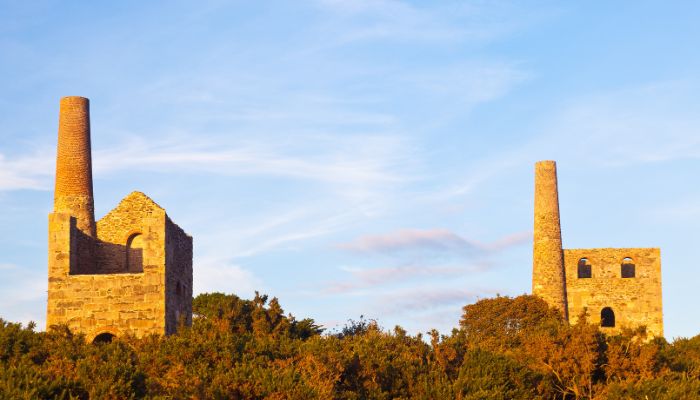
The Grade II listed Pednandrea chimneystack has been a landmark overlooking the district since 1824.
East Pool Mine
The famous East Pool Mine, on Agar Road, Pool, Redruth, remained operational until 1945, mining tin and copper. The best-preserved historic mine in the area, it is now owned by the National Trust and is one of Cornwall’s major visitor attractions.
It boasts a mighty Cornish beam engine and gives modern visitors an insight into life in a mining area in years gone by, as it nestles in the heart of the Cornish Mining World Heritage Site.
Penance Consols Mine
The remains of the Penance Consols mine are located between Redruth and Lanner, at Carn Marth. When it first opened in 1836, there were only four employees.
First known as Wheal Amelia, it was renamed Penance Consols in 1850. It had three shafts and an engine house which was installed in 1866. However, sadly, it closed in around 1874, due to natural resources dwindling and the price of copper falling. Only 590 tons of copper were extracted between 1866 and 1872.
An attempt to start mining tin failed and although the mine reopened briefly between 1880 and 1881 as East Wheal Buller, this was unsuccessful.
Today, only Baronet’s Engine House remains on the site, but it still attracts visitors on the Cornish heritage trail.
Wheal Peevor Mine
Wheal Peevor in Redruth is also a visitor attraction today. Located around 1.5 miles northeast of Redruth, on North Downs, mining began there in the early 18th century, on the St Aubyn family’s land.
It operated until 1889, initially as part of Great North Downs mine and then as Wheal Peevor from 1872. It employed around 150 workers underground in the early 19th century and the number had grown to 300 by 1880.
However, as the price of tin dropped and large untapped tin mines started to open in the Far East, attracting thousands of miners to work abroad, Wheal Peevor suffered the fate of other local mines, closing in 1889.
Exploratory work on the site took place during the 20th century, but it has never reopened. The mine’s remains are a visitor attraction today.
How to Visit Redruth’s Historic Mines
Steeped in history, Redruth is the perfect location for scenic walks. The Globe Vale area is well-known for its mining heritage, with a classic Cornish landscape that has the highest concentration of historic mining sites anywhere in the world. Wheal Peevor is just around the corner from our 5* Cornwall camp site. Park for free, visit our onsite restaurant The Shaft Inn for lunch and explore the landscape at your will. The old mining chimney of Pednandrea is also close by and is one of many beautiful scenic walks you can take straight from the holiday park.
There are also several museums in the local district dedicated to preserving and showcasing the history of mining such as the Moseley Heritage Museum, The Cornwall Centre, Kresen Kernow and the Heartlands Mining World Heritage Site, which is a family-friendly 19-acre visitor attraction.