© chrisdorney / Shutterstock.com
Cornwall has a fascinating history of myths, legends, and historic castles that stretches back thousands of years, making it a great topic to explore. Historians and storytellers alike have long been drawn to Cornwall’s rich heritage, from tales of Jack the Giant Killer and the Archangel Michael to smugglers and King Arthur. Learning about this heritage can add an extra layer of interest to family holidays in Cornwall.
Exploring the historic castles and ancient landmarks in Cornwall has played a major role in shaping the region’s cultural identity. Many families camping in Cornwall enjoy visiting these historic sites to help children connect with the landscape around them. Today, many Cornwall landmark sites are protected and can be explored safely with children through organisations like the National Trust and English Heritage, which care for several family-friendly historic locations across Cornwall.
The History of Tintagel Castle
Tintagel Castle is one of the most famous Cornish castles, dating back to the 13th century AD. The historic monument stands partly on the mainland and partly on the coastal headland adjacent to Tintagel village, creating a striking landmark for anyone exploring the rugged North Cornwall coast.
Built by King Henry III’s younger brother Richard, Earl of Cornwall, in the 1230s, it’s on the site of a previous stronghold from the 1140s. Long before this, a coastal community existed during the final days of the Roman occupation of Britain, with fragments of pottery, dating from the 5th to 7th centuries AD, being found there.
Geoffrey of Monmouth, a 12th-century cleric and author of The History of the Kings of Britain, popularised the legend of King Arthur’s links to Tintagel in 1136. His book described how Arthur’s father, Uther Pendragon, the King of Britain, went to war with the Duke of Cornwall, Gorlois, in the 5th century. Later, Arthur was conceived at Tintagel and went on to become a great military leader and king.
While modern-day historians have debated the authenticity of this account, the mystical association of Arthur and the Knights of the Round Table has kept the legend of Tintagel Castle alive for centuries, making it a top priority for family holidays in Cornwall.
St Michael’s Mount

The iconic St Michael’s Mount is an island located at Mounts Bay off the Cornish coast. With a long and mysterious history, dating back to the 5th century AD, it was said that seafarers were lured by mermaids towards the rocks, only to be saved by the Archangel Michael, who guided them to safety. The patron saint of fishermen, St Michael was known for his strength and courage in helping people in peril.
Today, St Michael’s Mount, a 247-acre island, is home to a historic castle, harbour and gardens, which can be accessed from the coastal town of Marazion at mid and low tide by a man-made causeway.
In the 8th century, construction began of a Benedictine monastery on the island. It later became a chapel and a popular destination for pilgrims. Home to the St Aubyn family since the 1650s, St Michael’s Mount is managed by the National Trust today. The 12th century castle invites visitors to walk its ancient corridors, tracing the island’s history.
In bygone times, islanders knew of another Cornish legend, Cormoron the giant, who lived on the Mount and terrorised the locals, stealing their cattle. His reign continued until a young man from Marazion, Jack, decided to rid the island of its unwelcome guest. He lured Cormoron out during the night and set a terrible trap, earning himself the name, Jack the Giant Killer, but you’ll have to visit the castle to find out what happened!
The Jamaica Inn
In 1750, the Jamaica Inn was built as a place where weary travellers could rest during long journeys on horseback or in carriages, staying overnight while travelling between Bodmin and Launceston across the wild moors. Some were smugglers, who used the inn to hide contraband goods that had been brought to Cornwall by boat, including brandy and tea, as its remote location made it an ideal place to store goods that had arrived along the Devon and Cornish coasts.
To add stables, coach house and tack room, the inn was extended in 1778 to the L-shape we know today. Visitors can relive the journey of former guests at the Smugglers’ Museum, home to one of Britain’s largest and finest collection of smuggling artefacts. They can also watch The History of Jamaica Inn that tells the legendary tales associated with the inn’s 300-year history.
In the early 1930s, young author Daphne du Maurier became lost in fog while out riding on the moors during a holiday in Cornwall. She and her friend were taken by their horses to safety at the Jamaica Inn, where the inn keeper told them ghost stories – the inspiration for her 1936 novel, Jamaica Inn.
Bodmin Moor: Prehistoric Landscapes and Elusive Beasts
Bodmin Moor is home to many protected and rare animals and plants, including songbirds, bats, otters and marsh fritillary butterflies. It’s also famous for its natural rock formations, including the Cheesewring at Stowe’s Hill, north of Liskeard, which is a geological formation of stone slabs that resembles a giant stack of cheeses.
The history of Bodmin Moor dates back to 10,000 BC, when the land was covered by a forest, but early settlers transformed the landscape by clearing large areas for agriculture.
One of the most famous Cornish myths is the Beast of Bodmin Moor: a black panther-like animal is believed to roam the wild moorland. There have been many sightings reported over several decades, and videos have been posted of a large cat-like creature.
While agriculture ministers have found no proof of the beast, its legend lives on, with people suggesting it has escaped from a private collection or been released because it grew too big to contain. The moor has changed little for 1,000 years and is used today for summer grazing – livestock are given winter shelter in the adjacent farms, making it a beautiful, untamed destination for families hiking in Cornwall.
Launceston Castle: Power, Prisons and the Duchy of Cornwall
Historic Launceston Castle was the centre of government in Cornwall and an important fortress for 600 years. Construction began in 1068, following the Norman Conquest. Over the centuries, further building work was completed, including a high tower in the early 13th century. During the 13th and 14th centuries, it was an aristocratic residence and the hub of the Duchy of Cornwall. In the 18th and 19th centuries, it was used as a courthouse and prison.
Today, the castle is owned by the Duchy of Cornwall and remains a prime example of Cornwall’s heritage. A popular visitor attraction, it hosts guided tours, or families can simply stroll around to soak up the ancient, historic atmosphere.
Where to Explore Historic Landmarks and Castles in Cornwall
Many of these sites can be easily accessed on popular walking trails and make great photo opportunities for the whole family.
St Agnes Beacon and Wheal Coates Walk
Length: 2.9 miles, ~1.5-2 hours
Difficulty: Moderate
Terrain: Rugged coastal footpaths, dirt tracks, and a short stretch of minor road. Features some steep inclines and stone stiles; can be muddy after rain.
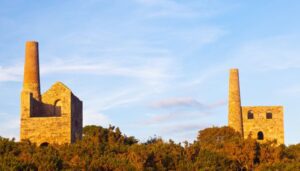
Summary: A spectacular circular route located right on Globe Vale’s doorstep. This trail takes you up to the summit of St Agnes Beacon for sweeping 360-degree views of the coastline before heading down past the iconic, dramatic ruins of the Wheal Coates mining engine houses perched right on the cliff edge. Kids will love exploring the historic clifftop ruins.
Parking: Free Parking at the National Trust clifftop car park, or paid council parking is available in the village but will require a 30-minute walk to reach the summit

Tintagel to Rocky Valley Circular Walk
Length: 3.4 Miles, ~ 2 Hours
Difficulty: Moderate
Terrain: Rugged, narrow coastal paths with cliff edges, turning into woodland tracks and riverside paths. Requires sturdy walking shoes for uneven and rocky sections.
Summary: A highly atmospheric and beautifully scenic walk that combines legendary history with dramatic coastal vistas. Starting in Tintagel village near the castle, the route follows the South West Coast Path past stunning coves before turning inland to explore the magical, wooded gorge of Rocky Valley with its mysterious historical rock carvings.
Parking: The closest car park is the Bossiney Cove Car Park, only half a mile north of Tintagel, costing around £3 for the day
Bodmin Moor and Brown Willy Circular Walk
Length: 7.0 Miles, ~ 3-4 Hours
Difficulty: Hard
Terrain: Open moorland, grassy tracks, and rocky heathland. The ground can be uneven, boggy in places, and steep during the ascent to the summit.
Parking:
Summary: A rugged and rewarding trek through the untamed heart of Cornwall. Starting and finishing at the historic Jamaica Inn, this circular route explores wild moorlands and ancient prehistoric landscapes, taking you to the top of Brown Willy, Cornwall’s highest point
Parking: Rough Tor Car Park is the free parking spot right at the end of a narrow no-through road at the starting point of the hike, but it does fill up quickly, especially around mid-morning
When you’re planning a holiday in Cornwall, book your stay at Globe Vale Holiday Park in Redruth, from where you can explore some of the region’s rich history and legends—St Agnes Beacon and the historic Wheal Coates ruins are right on the doorstep of the park, so you won’t have to go far!