© ian woolcock / Shutterstock
Cornwall has a long history of mining, dating back around three thousand years. Historians believe Cornish tin mining began in around 2100 BC, as the county had plenty of mineral mines compared with the rest of Britain.
China clay, tin and copper mining have always been important in Cornwall. The region’s geology became so rich because the land was formed from a granite mass millions of years ago. Fissures on the earth’s surface allowed molten rock to surge through the granite.
As it cooled and solidified, the new rock was incredibly rich in minerals such as lead, tin, copper, zinc, silver and iron. Tin and copper were particularly useful to the early humans, as they were used to make weapons.
Roman metals trading
When the Romans arrived in Cornwall, in around 43 AD, tin and copper were valuable commodities. Historians believe the Romans were keen to trade goods for copper and tin. They shipped the metals to mainland Europe and had an economic relationship with the Cornish suppliers.
As a result, it appeared Cornwall wasn’t considered a military threat and the Romans left few signs of a major occupation of the county. Several Roman forts remain and a typically Roman villa was erected at Magor, near Camborne, but the copper and tin mining had possibly saved Cornwall from a full-scale military invasion.
Tin mining boom
The lure of tin trading heralded the arrival of ships from the eastern Mediterranean in the sixth century, bringing luxury goods for the Cornish people, such as wine and olive oil.
By 1337, Cornish tin production had rocketed to 650 tons per year, and 800 tons by 1400. During the 1540s, production was booming, using open cast mining methods. Somerset inventor Thomas Epsley revolutionised the industry in 1689, when he devised a new method to blast the granite rock with gunpowder.
One blast moved the same amount of rock in an instant that it would take a group of miners with pickaxes six days to dislodge. The demand for tin continued to grow and even small mines were able to benefit from the huge market.
Copper mining
In the 1700s, the brass industry expanded, largely as a result of the growing woollen industry, where brass combs were needed. The demand for copper grew again as a result. It was found in many areas of Cornwall, often under the tin lodes. Deeper mines were needed, and this meant introducing better drainage methods to improve conditions for miners.
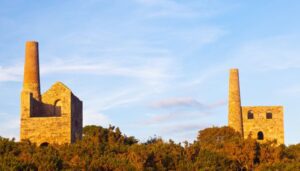
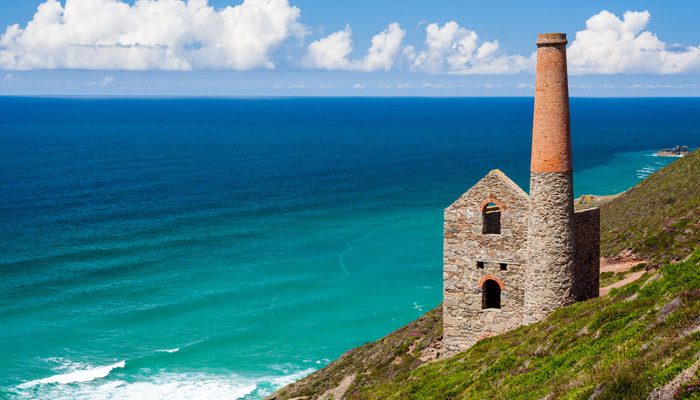
Steam engines were introduced in the 1730s, and with them came the icons of the Cornish landscape, the engine houses. They were found all over the mining districts by the 1750s.
The booming demand for copper grew further in the 1800s when it was used for coins and for the expansion of the Royal Navy due to conflicts at sea. The mining industry grew dynamically as a result.
China clay mining
China clay mining arrived in Cornwall much later. The material was first used in China to fashion high-quality white porcelain. When the beautiful items were traded in Europe, the wealthy wanted a change from earthenware pots. Porcelain became highly sought-after.
Plymouth apothecary William Cookworthy spotted a gap in the market and started to search for a material similar to the kaolin used in China for porcelain-making. In 1745, visiting Tregonning Hill, in Cornwall, he discovered a rare kind of natural granite that was finer than talcum powder.
Known locally as Growan, Moorstone, or Growan Clay; Cookworthy experimented with the material and found a way of separating it to remove impurities, using water. He spent 20 years developing a recipe to make porcelain, patenting his invention in 1768.
He founded the Plymouth Porcelain Factory, where he made fine china to sell to the wealthy, using china clay mined in Cornwall. He also started selling the raw material to other English potteries.
Mining centre of the world
By the late 18th century, Cornwall was the mining centre of the world. Mine owners led the global industry in terms of new, innovative technology. Local expertise was used as a basis for new mining regions around the world. International mining communities started to spring up.
Copper mining peaked in the 1850s, with the discovery of new copper reserves in east Cornwall – keeping production going at the same level until the mid-1860s.
The famous Camborne School of Mines was founded in 1888 in Falmouth, Cornwall. The university and mining school is still going strong today as part of the University of Exeter.
Life of a miner
The life of a miner in the 19th century was tough. Mine shafts were narrow and often vertical, and the miners worked in cramped, hazardous conditions. Many mines had basic ladders for access. Having to climb up and down them, in the heat and dust, added to the daily grind. Some mine owners invested in cages to transport the workforce up and down, but plenty didn’t.
Arsenic was found underground in some mines, making the work even harder – miners often didn’t live past middle age. As well as men working underground, an estimated 7,000 children worked in mines in the mid-19th century. Boys were sent down the mine shafts to do an adult’s work as soon as they were physically able.
Women and girls were also employed by mine bosses, but they worked above-ground, sorting through the ore and separating different materials.
Cornish pasties
The traditional Cornish pasty was the staple diet of every miner. It had many advantages: it was light and easy to carry, as it could be slipped in a pocket and taken underground. The miners normally ate in the mine shaft, as there wasn’t enough time to take a break above-ground.
A Cornish pasty consisted of pastry containing meat and potatoes. However, some were savoury at one end and sweet at the other with jam, fruit or treacle – providing the main course and a dessert all in one! This trend has vanished today, although savoury Cornish pasties are now famous worldwide.
The thick pastry helped keep the filling warm. There was nowhere for the miners to wash their hands before dining, so the pastry had a thicker fold on one edge, so they could hold onto this and throw the soiled piece of crust away.
Mining industry decline
Following the mid-19th century boom in Cornish mining, the industry began to decline, largely due to cheap foreign competition. The price of tin and copper was eroded and the industry became less profitable in Cornwall.
Many workers faced redundancy at the end of the 19th century. Thousands emigrated overseas to find work, to places such as South Africa, Australia and North America, where the mining industry was relatively new. More than 10,000 miners reportedly left Cornwall to find work elsewhere.
Cornish mines began to close during the 20th century – and in 1986, a crash in the price of tin worldwide caused further downturn for the Cornish industry. The last working tin mine at South Crofty, near Camborne, closed in March 1998.
China clay is still produced around St Austell, the majority at Fowey and smaller quantities coming from Par Harbour. The Wheal Martyn China Clay Heritage Centre details the region’s historic china clay mining industry.
Tourist attractions
Today, the old mines and mining heritage are integral to the tourism industry in Cornwall, as many are World Heritage Sites owned by the National Trust. Mines such as South Crofty, East Pool Mine and Wheal Peevor are tourist attractions in their own right.
The South Crofty project, in the Pool and Camborne district, may see the old mine reopen in the future. A number of organisations, led by Cornish Metals, are collaborating on a feasibility study into whether the mine can become active again.
East Pool mine was operational, mining copper and tin in the Camborne and Redruth area, until 1945. Today, it is a famous visitor attraction and still has its iconic engine houses, Cornish beam engine and industrial heritage discovery centre.
Wheal Peevor Mine Site and multi-use trail, managed by Cornwall Council, opened as a visitor attraction in 2008. The site contains three Grade II listed engine houses, and the former derelict land is now used for recreational and educational purposes.
When you’re planning a holiday in Cornwall, book your stay at Globe Vale Holiday Park in Redruth, from where you can explore some of the region’s rich mining heritage – Wheel Peevor is on the approach road to the park, so you won’t have to go far! The holiday park hosts a range of tent and caravan pitch options and luxury holiday caravans, including an exclusive spa lodge.