© Samot / Shutterstock.com
Launched in the 19th century to care for Britain’s historic buildings, places and our beautiful countryside; the National Trust continues to protect and care for many noteworthy places so people can enjoy our heritage, while nature and wildlife thrive. Staff, volunteers, members and supporters make the National Trust Europe’s biggest conservation charity.
History of the National Trust
Founded in 1895 by social reformer Octavia Hill, Anglican priest Canon Hardwicke Rawnsley and solicitor Sir Robert Hunter; the National Trust celebrated its 125th anniversary in 2020.
Hill had the original idea of forming a charity in 1884, recognising a need to stop the destruction of the natural landscape following the industrial revolution. She was a landlord who helped London’s poor, making a modest return of only 5%. This was ploughed back into her properties’ upkeep and improving the community. She became the “friendly face” of rented properties. Her scheme was a success and after more investors got on board, it expanded, having more than 3,000 tenancies around London by 1874.
Spending much of her time in urban housing estates, with no trees, she was convinced the masses needed open spaces. She said they needed to “rise above the smoke” and “feel the refreshing air” in order to feel better emotionally.
With this in mind, she enlisted the help of Hunter, the Commons Preservation Society’s solicitor; and Rawnsley, a well-known conservationist. Their first successful campaign saved Vauxhall Park, Parliament Hill Fields and Hilly Fields in London from development.
In 1895, they officially founded the National Trust for Places of Historic Interest or Natural Beauty. Its mission statement was that green spaces must be preserved for the “enjoyment and refreshment” of people who weren’t lucky enough to have a country house.
Since the charity was founded, it has continued to save historic buildings, gardens and open spaces, its modern guardians continuing the legacy of its founders. Members of the National Trust enjoy many benefits, including free entry to more than 500 places in its care. They also have special access to the website’s members’ area, where they can enjoy behind-the-scenes features of some of the historic homes and first-look previews of attractions.
National Trust locations in the South West
The South West of England boasts some of the most beautiful National Trust houses and gardens in the UK. In particular, Cornwall has a rich cultural, historic and environmental heritage that sets it apart from other English counties.
There are around 50 National Trust sites all over Cornwall, ranging from stretches of coastline to historic buildings. You can learn about the fascinating Cornish history at the county’s historic sites.
If you’re planning a staycation in Cornwall this summer, have an action plan to visit a number of different sites. The beauty of National Trust sites is that they can be enjoyed by everyone, whether you go as a family, a couple, or with friends.
Antony House
Antony House was built in the 18th century, within a magnificent landscape garden, between the town of Torpoint and the village of Antony. It is still home to the Carew Pole family today. The ancestors of today’s family members lived at Antony House through the English Civil War.
Built using silver-grey stone, the historic house is a mixture of formal and informal elements. Described as one of the finest Queen Anne properties in the West Country, it displays an amazing collection of portraits, including a famous painting of Charles I and works by Sir Joshua Reynolds. There are also stunning examples of tapestries, period furniture and textiles.
You can explore the landscape garden, where topiary mingles with modern sculptures and the famous National Collection of Daylilies. Antony House was used as a film location for director Tim Burton’s blockbuster, Alice in Wonderland.
Cotehele
Cotehele is an atmospheric Tudor house at St Dominick, Saltash. With Medieval roots, it features a working mill on an ancient quay. It also boasts a glorious garden with breathtaking valley views and a sprawling estate that you can explore.
The ancestral home to the Edgcumbe family, the Tudor house stands above the River Tamar. With tapestries, armour and arms, old oak furniture and pewter and brass a plenty; the interior has changed little over the years.
Outside, there are formally planted terraces, the Valley Garden, a Medieval fishpond and a dovecote.
Lanhydrock
Lanhydrock is a magnificent Victorian country house, with a wooded estate and spacious garden. It has the feel of a historic family home that is wealthy but unpretentious. The house was refurbished in opulent Victorian-style following a fire in 1881.
Visitors can find out about two different sides of Victorian life. View the luxurious family areas, including the spacious bedrooms and elegant dining room. Contrast this with life “below stairs”, including the kitchen, where the servants would have prepared the family meals.
Walk around the beautiful gardens, which are a blaze of colour all year round. They are home to herbaceous borders, a higher garden full of magnolias, camellias and rhododendrons and a formal parterre garden.
Trerice House
Located in the parish of Newlyn East, near Newquay, Trerice House is an Elizabethan manor house with luxurious interiors and delightful gardens. This intimate manor house is a Cornish gem, as it has changed little over the centuries, largely due to long periods when its owners were absent – so few upgrades were carried out.
The historic rooms take you on a journey through time. Highlights include the original 16th century glass in some of the 576 panes in the windows of the Great Hall.
Trerice also has a historic barn that is almost as big as the house. Used for storing grain in its heyday, it has been sympathetically transformed into the Barn Restaurant.
Glendurgan Garden
Glendurgan Garden is located in the pretty hamlet of Durgan. The exotic valley garden features a large maze and a giant tulip tree. The garden is around 6.8 miles from Falmouth, on the Helford River, in the civil parish of Mawnan; it has its own sheltered beach.
Famous garden designer Alfred Fox laid out the garden in the 1820s and 1830s. It was given to the National Trust by Philip and Cuthbert Fox in 1962. One of the most popular features of the garden is the cherry laurel maze, dating from 1833. It also has three valleys, where you can immerse yourself in the natural beauty and amazing plants.
The jungle-like lower valley has plants with huge leaves and exotic flowers, while plants that thrive in the sun cover the upper banks. Thousands of wildflowers carpet the sloping sides of the steep valleys in spring and summer.
Godolphin
Around 4.4 miles from Helston; Godolphin is an ancient and atmospheric estate, with a historic house and Medieval Garden. Rich in wildlife and archaeology, it feels like you have travelled back in time as you walk around the 16th century garden, which is one of Europe’s most important historic gardens.
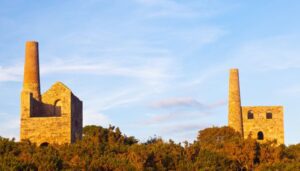
The wider estate has an engine house and stack, which were part of the Godolphin family’s mine. Enjoy some of the best views in Cornwall, as you look across to St Michael’s Mount to the south and St Ives Bay to the north.
Where to stay in Cornwall
When you’re planning a holiday in Cornwall, it’s a good idea to stay in a pleasant location within easy distance of some of the fascinating National Trust properties. Globe Vale Holiday Park is a family-run park, set in the heart of Cornwall’s beautiful coastlines – we’re open all-year round!
A dog-friendly campsite, set in 20 acres of land; we have stunning views spanning across rolling fields to St Agnes Beacon and the coast. Nestling in a landscape of mature trees and shrubs, Globe Vale is a special location, whether you’re touring, camping or hiring a caravan. For information, email info@globevale.co.uk or call 01209 891183.